

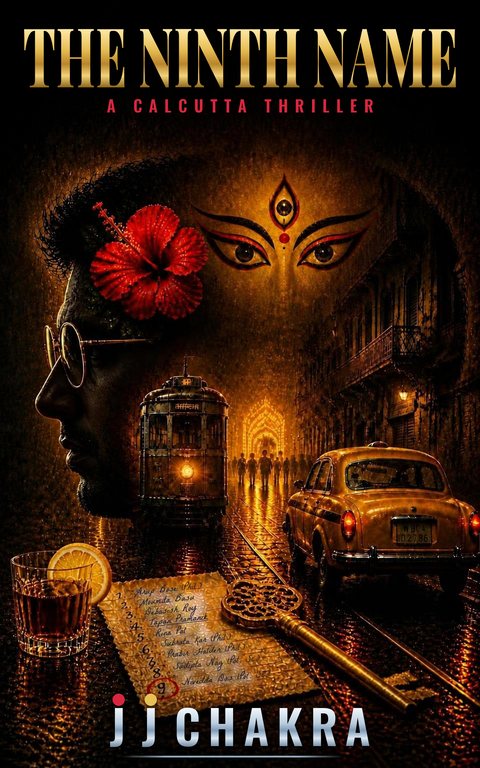
The Ninth Name
A Calcutta thriller
JJ Chakra
Read the first chapter free. If it keeps you, the rest of the book is one tap away.
Paperback and other Amazon stores
Chapter 1
A Quiet Life
On Monday, the eighteenth of August, 2025, somebody let themselves into Rudranil Chatterjee’s flat with a key.
They took nothing. They opened the one thing in it he had never shown anyone, and they left something inside.
He would not find it until that night, with his second drink. Until then it was an ordinary Monday, and he lived it the way he lived all his days: in strict order, and quite sure that nobody was watching.
Rudranil Chatterjee had the kind of face that could vanish into the backdrop of a city. A long face, a strong nose, heavy brows over eyes that were perennially tired but alert, as if they were always halfway through a sentence only he could read. He was six feet tall and carried it like an apology. Wide shoulders from the basketball years. A frame that had since gone soft at the middle.
He taught philosophy at Vidyasagar College. Or, as he had once told Dipen da, the friend he had called elder brother since they were boys, over cold coffee at the Indian Coffee House, “Academic babysitting for confused souls with Wi-Fi.”
Dipen had laughed so hard a waiter in a turban had come over to check on him.
The flat was in Lake Gardens. Second floor, two rooms, “full of character”, which was what brokers said when they meant damp. Rain-stained walls. A water heater that puffed and gasped like an old Marxist climbing stairs, but never failed. A radio older than some of his students, which only picked up All India Radio when the wind blew east.
And Søren.
Søren was a rubber plant, christened after Kierkegaard because both were moody and both leaned towards the light without admitting it. He had lived on the balcony until the new building went up next door and stole the sun. Now he lived on the landing, beside the stairwell window, in a cracked clay pot with a spare key under it. Rudranil had locked himself out once, in the winter of 2022, and spent a night on Dipen’s sofa in Salt Lake. Never again. The key had lived under Søren ever since.
Nobody knew. That was the point of a spare key.
The monsoon had not finished with Calcutta yet.
It had rained all night, the heavy, sulking rain of August, and Lake Gardens smelled of wet brick and frying oil. Somewhere a pressure cooker whistled three times. Somewhere a crow said what crows always say.
Every day ran like the old wall clock in his parents’ house: slow, a little sad, and exactly on time.
6:52 a.m. — Woken by a pigeon with opinions. 7:03 a.m. — Teeth, brushed with care, in a mirror that looked at him like it owed him rent. 7:10 a.m. — The first roll-up of the day. Tobacco, paper, a matchstick. Never a lighter. Lighters were for people in a hurry. 7:20 a.m. — Black coffee, no sugar. Life was bitter enough.
Seven cigarettes a day. He rolled each one at its hour, and never one more.
Breakfast was sacred. Two thick slices of local bread toasted directly on the flame, Amul butter, black pepper. Two poached eggs, made standing over a battered saucepan on the most temperamental gas burner in Bengal. He plated it all on a chipped bone china plate with faded pink roses. His mother had given it to him when he moved to Calcutta, wrapped in two issues of Anandabazar Patrika, the Bengali daily, and a lecture about eating properly.
He ate in silence, like it was a prayer.
Epicurus once wrote to a friend begging for a small pot of cheese, so that he could feast whenever he liked. Rudranil told his students every year that this was the high point of Greek philosophy, and that everything after it was footnotes. Bread, butter, two eggs, a quiet room. A man needed very little to be happy. He only needed to be left alone.
He was fifty-one, with teeth he cared for, nails he did not, and reading glasses that lived in his jhola, his cloth shoulder bag, and that he never wore. He held exam papers at arm’s length instead. On winter nights he rubbed Boroline, the antiseptic cream in a green tube that so many Bengali homes keep, into his cracked heels, and he smelled faintly of it always: Boroline, old pages, tobacco, and coffee brewed a little too long.
He dressed for college the way he always did. A white shirt and grey trousers, both ironed to a knife’s edge by Haru, the dhobi on the corner, washerman to half the lane, who had been pressing his shirts for six years and his opinions for five.
“Dada, aaj brishti thambe na,” Haru had said on Saturday, handing over the bundle. Brother, the rain won’t stop today. He said it every Saturday from June to October, and he was right roughly half the time, which was better than the weather office.
Polished black leather shoes. And then, over his shoulder, the jhola. It was so frayed it looked like it had union rights. “The jhola cancels out the ironing,” Dipen always said.
“It’s a balanced look,” Rudranil always said.
At home he lived in kurtas, long loose cotton shirts. At college he dressed like a man who meant it. He had never been able to explain the difference, even to himself.
He wound his father’s HMT watch. It ran two minutes slow. He had never corrected it. His father had given it to him the day he left Durgapur for Calcutta, at eighteen, and had said only, “Keep time.” Rudranil had kept it. He had simply never kept it right.
On the landing he paused beside Søren.
“You look well,” he said.
Søren said nothing. That was the great virtue of plants.
The Metro from Rabindra Sarobar carried him north under the city, past Kalighat, past Esplanade, into the old Calcutta of Girish Park, where the streets narrowed and the walls leaned in to listen. Above ground, the rain had paused. The tram wires still hung over the roads, though hardly any trams ran on them now. Calcutta kept its wires the way an old man kept his letters.
Vidyasagar College stood on Sankar Ghosh Lane, near College Street, as it had for longer than anyone in the staffroom could remember. The corridors smelled of damp notebooks and rehydrated ambition.
His eleven o’clock was Heidegger. Thirty-one second-years and a ceiling fan with a limp.
“Sir,” said a girl in the third row, twirling her pen like a baton, “what does being-toward-death even mean?”
Rudranil looked at her.
“It means,” he said, “you should call your mother more often.”
“And if she calls too often, Sir?”
“Then she has read Heidegger too,” said Rudranil.
The class laughed. He did not. Both his parents were alive, a hundred and seventy kilometres up the Grand Trunk Road, in a steel township where his mother had taught Bengali grammar to forty years of other people’s children. She had called on Sunday. He had let it ring twice, then answered.
“Khaoa-dawa thik moto korchhish?” Are you eating properly? The same question for thirty-three years, as if he had left home last week.
“Hyan, Ma.” Yes, Ma.
“Aaj ki kheyechhish?” What did you eat today?
“Eggs, Ma. Toast.”
“Shudhu dim-pauruti? Ota abar khabar holo?” Just eggs and bread? You call that food?
“Pujo-te ashchhish to?” You’re coming home for Durga Puja?
“Dekhi, Ma. Kaaj achhe.” We’ll see, Ma. There’s work.
He was not busy.
Lunch in the staffroom. Toast, tea, and theoretical despair.
He marked their last assignments with a red pen. Blue felt dishonest. Red at least admitted it was bleeding. Then he reached into his jhola for the notebook, to write down the line about mothers before he lost it.
It was not there.
He went through the jhola twice. Lecture notes, glasses, matches. No notebook. He could see exactly where it was: on his desk at home, beside the coffee cup, where he had left it that morning. He had not done that in months.
He felt its absence all afternoon, like a missing tooth.
He was home by six. The rain had come back, softer now, like it was apologising.
He changed into a faded kurta and made the evening drink. Old Monk, the dark Indian rum. A slice of lemon. Lukewarm water. A drink that tasted like a reluctant memory. He was not bitter. He was pickled.
He took it to the window and watched the lane.
A boy on a cycle with a gas cylinder. A woman with a jute bag full of bananas, her umbrella tipped against the rain like a shield. The phuchka seller under the neem tree, covering his glass box of street snacks with plastic, open for business anyway. Calcutta did not stop for rain. It merely complained, and carried on.
His phone buzzed at eight. He knew who it was before he looked. Nobody else called him at eight.
“Baba!” Daddy!
“Mishti-maa.”
“Guess what. Guess.”
“You’ve been made Prime Minister.”
“Baba.” A sigh only a ten-year-old can produce. “I got the part. In the play. I’m the banyan tree.”
“The talking banyan tree?”
“The talking banyan tree. I have nine lines. Ma says I have to practise every day. Will you come?”
“When is it?”
“The Saturday before Mahalaya. Ma has it on the calendar. You’ll come?”
Mahalaya: the dawn, a week before Durga Puja, when half of Calcutta wakes at four to a voice on the radio. A month away.
“I’ll come.”
“Promise?”
“Promise.”
He heard Chandrani’s voice in the background. “Mishti, dudh-ta shesh koro.” Finish your milk. Calm. Measured. A voice trained to sing Tagore’s songs and to say difficult things without raising itself. They had been married for twenty years. She had left three years ago, not with a slammed door but with a folded note and a reasonable tone, and somehow that had been worse.
He had not fought for her. That was the sentence he did not write in his notebook.
“Okay, I have to go,” said Mishti. “Baba?”
“Hmm?”
“Come soon.”
She always ended like that. Baba, come soon. As if he were always somewhere far off, even when he was only half an hour away.
“Soon,” he said.
She hung up first. She always did.
He sat at his desk with the second drink and the notebook.
It was a black leather notebook, its spine cracked and mended with tape. On the first page, in his father’s fountain pen, he had written two words years ago: Unverified Truths. Under them, smaller, two more words, borrowed from Epicurus: Live unnoticed. He had kept that rule for twenty-two years.
Inside were the things he thought between lectures, too small for an essay and too stubborn to forget.
Loneliness isn’t an absence. It’s wallpaper. Meaning doesn’t arrive. It accumulates. Calcutta doesn’t age. It ferments.
He had not even shown it to Chandrani. It lived in his jhola by day and on his desk by night, and nobody else had ever touched it.
He uncapped the fountain pen. He meant to write something about the banyan tree, about nine lines and a promise.
He opened the notebook.
There was a yellow square of paper stuck to the page where he had stopped writing. A post-it, the cheap kind sold in packets of a hundred at every stationery shop on College Street.
The words were typed.
Not handwritten. Typed, on a printer, and cut to size, and stuck down neatly, edge to edge, by someone with steady hands.
Memory is unreliable. But so is comfort.
Choose your weapons wisely.
He read it twice. Then he held it at arm’s length, the way he held everything, as if distance would make it make sense.
It did not.
It had lain right here all day, shut, in his own flat, behind a door he had locked himself.
He looked up.
The flat looked exactly as he had left it. The radio on its shelf. The chipped plate in the rack. The curtain at the window, straight.
Too straight.
He did not remember straightening it.
Out on the landing, Søren stood in his cracked clay pot, with a spare key underneath him that nobody knew about.
Rudranil sat very still and listened to the rain.
Live unnoticed, said the first page of his notebook.
Somebody had noticed.
For the first time in three years, he was not alone in his own flat. He was almost sure of it.
He reached for his matchbox. It was only half past eight. His eighth cigarette of the day.
He had never smoked an eighth.
Who opened his notebook?
Rudranil has one rule: live unnoticed. Now a typed note, a woman who knows his timetable, and a list in his own handwriting from February 2003 are about to take that rule apart. Keep reading on Kindle, or in paperback.
Other Amazon stores and the paperback (US, UK, Germany)
Kindle Unlimited members read it free.